
Beliefs of New Life & the Presbyterian Church in America (PCA)
The Bible is the inspired and inerrant Word of God, the only infallible rule of faith and practice.
There is one God, eternal and self-existing in three persons (Father, Son and Holy Spirit) who are to be equally loved, honored, and adored.
All mankind participated in Adam’s fall from his original sinless state and is thus lost in sin and totally helpless.
The Sovereign God, for no other reason than His own unfathomable love and mercy, has chosen lost sinners from every nation to be redeemed by the quickening power of the Holy Spirit and through the atoning death and resurrection of His son, Jesus Christ.
Those sinners whom the Spirit quickens, come to believe in Christ as Savior by the Word of God, are born again, become sons of God, and will persevere to the end.
Justification is by faith and through it the undeserving sinner is clothed with the righteousness of Christ.
The goal of God’s salvation in the life of the Christian is holiness, good works, and service for the glory of God.
At death the Christian’s soul passes immediately into the presence of God and the unbeliever’s soul is eternally separated from God unto condemnation.
Baptism is a sign of God’s covenant and is properly administered to children of believers in their infancy as well as to those who come as adults to trust in Christ.
Jesus Christ will return to earth, visibly and bodily, at a time when He is not expected, to consummate history and the eternal plan of God.
The Gospel of God’s salvation in Jesus Christ must be published to all the world as a witness before Jesus Christ returns.
These and other truths are affirmed in various statements of faith from the early church, such as the Apostle’s Creed and Nicene Creed. We also stand within the rich tradition of the Reformation of the sixteenth century, which is anchored in the gospel of grace. The Westminster Confession of Faith is a beautiful expression of the central teachings of the Bible, and has served as the doctrinal standard for Presbyterians since the seventeenth century.
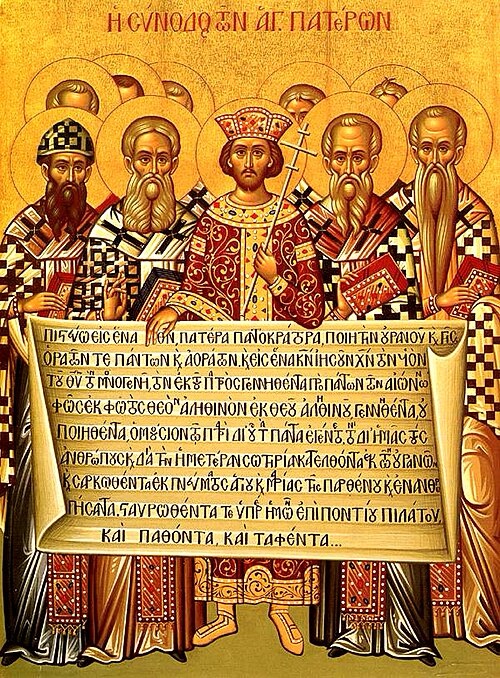
Art depiction of Constantine the Great, accompanied by the bishops of the First Council of Nicaea (325), holding the Niceno-Constantinopolitan Creed of 381. First line of main text in Greek: Πιστεύω εἰς ἕνα Θ[εό]ν, πατέρα παντοκράτορα, ποιητὴν οὐρανοῦ κ[αὶ] γῆς. Translation: “We believe in one God, the Father, the Almighty, Maker of heaven and earth.”
Apostle’s Creed
I believe in God, the Father Almighty,
the Creator of heaven and earth,
And in Jesus Christ, His only Son, our Lord,
who was conceived of the Holy Spirit,
born of the Virgin Mary,
suffered under Pontius Pilate,
was crucified, died, and was buried.
He descended into hell.
The third day He arose again from the dead.
He ascended into heaven
and sitteth at the right hand of God the Father Almighty,
from whence He shall come to judge the living and the dead.
I believe in the Holy Spirit,
the holy catholic church,
the communion of saints,
the forgiveness of sins,
the resurrection of the body,
and life everlasting.
Amen.
Nicene Creed
I believe in one God, the Father Almighty, Maker of heaven and earth, and of all things visible and invisible.
And in one Lord Jesus Christ, the only-begotten Son of God, begotten of the Father before all worlds; God of God, Light of Light, very God of very God; begotten, not made, being of one substance with the Father, by whom all things were made. Who, for us men for our salvation, came down from heaven, and was incarnate by the Holy Spirit of the virgin Mary, and was made man; and was crucified also for us under Pontius Pilate; He suffered and was buried; and the third day He rose again, according to the Scriptures; and ascended into heaven, and sits on the right hand of the Father; and He shall come again, with glory, to judge the quick and the dead; whose kingdom shall have no end.
I believe in the Holy Ghost, the Lord and Giver of Life; who proceedeth from the Father and the Son; who with the Father and the Son together is worshipped and glorified; who spake by the prophets.
I believe one holy catholic and apostolic Church. I acknowledge one baptism for the remission of sins; and I look for the resurrection of the dead, and the life of the world to come.
Amen.
Westminster Confession of Faith
Along with the Apostle’s Creed and Nicene Creed, we hold to the Westminster Confession of Faith. It is a faithful expression of the central teachings of the Bible, and has served as the doctrinal standard for Presbyterians since the seventeenth century.
 New Life Presbyterian